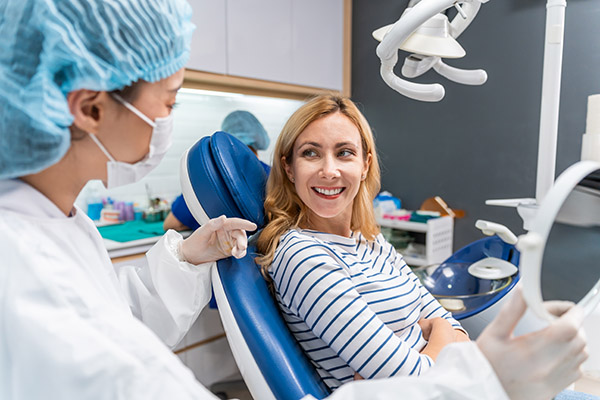
 Scaling and root planing is one of the procedures that periodontists use to treat gum disease. It is also known as deep cleaning, and it involves removing tartar and plaque from above and below the gum line.
The treatment is typically recommended when a person's bone structures and gum tissues around teeth have been damaged by advanced gum disease (periodontitis). It can also be used to reverse the first stage of gum disease, gingivitis.
Gum disease is an infection of gum tissues caused by the bacteria in plaque and tartar. Plaque is the sticky film that builds up on teeth after meals. It hardens into tartar when left on teeth for over a day. Tartar cannot be removed by brushing and flossing, so the bacteria are protected while damaging gum tissues and teeth structures.
Regular teeth cleaning treatments are used to remove tartar above the gum line, while scaling and root planing treatments are used to remove tartar from teeth roots and surfaces. The procedure also involves polishing teeth roots to make it harder for plaque and tartar to accumulate on them.
The scaling and root planing procedure
Deep cleanings are typically broken up into up to four treatments. The procedure involves manipulating gum tissues to reach teeth roots, which leads to a week-long recovery phase that often includes soreness and discomfort. Breaking up the treatment into multiple sessions makes recovery go smoother for patients. Here is what the procedure looks like:
- The periodontist starts by injecting the patient with a local anesthetic, which helps prevent hemorrhaging and numbs the area being worked on
- The patient remains awake while the periodontist performs the procedure, but they do not feel any pain
- The periodontist will remove tartar and plaque from beneath and between the patient’s gums, the roots of their teeth, and their bases
- The procedure is typically done with an ultrasonic or manual instrument
- The planing portion of the treatment involves polishing teeth roots to remove subgingival bacteria and smooth out rough spots
- Polishing teeth roots makes it harder for tartar deposits to form on them
- The patient’s teeth and gum pockets are then flushed to remove any bacteria left
- Pressure is applied to the patient’s gums to ensure proper tissue growth
Life after deep cleaning
It can take up to a week to recover from root scaling and planing. Common side effects that patients report include irritated gums, bleeding gums, swelling around the treated area, allergic reactions to materials used for the treatment, and mild discomfort.
Patients should avoid brushing aggressively right after the treatment. They should also avoid spicy and hot foods.
You can win the fight against gum disease
Root scaling and planing can be used to reverse the early stages of gum disease, and the procedure is used to manage the more advanced stages. Give us a call or stop by our Berkeley Heights clinic to learn more about the procedure.
Request an appointment or call Berkeley Periodontics and Dental Implants at 908-491-3201 for an appointment in our Berkeley Heights office.
Related Posts
A periodontist is a dental health professional specializing in treating gum disease. Their area of specialty is the tissues surrounding the teeth, meaning patients can visit them for procedures like soft tissue sculpting and grafting, and bone grafts.Conditions affecting the gums or the jawbone may sometimes cause no pain or discomfort. According to the American…
A periodontist may recommend a gum grafting treatment to patients whose oral health or appearance is affected by gum recession. Periodontists, or dentists who specialize in gum tissues, perform gum grafting operations regularly.Various factors can cause gum recession, including bacteria that cause gingivitis and recession, genetically thin tissue, orthodontic treatment, aggressive tooth brushing, smoking, tobacco…
Gingivectomy is one of the most popular treatment methods for periodontal disease. There are only a handful of treatment methods that can reverse the effects of periodontal disease. This procedure is one of them. It can bring the smile back to your face, making you more confident than ever before. Anyone facing the possibility of…